
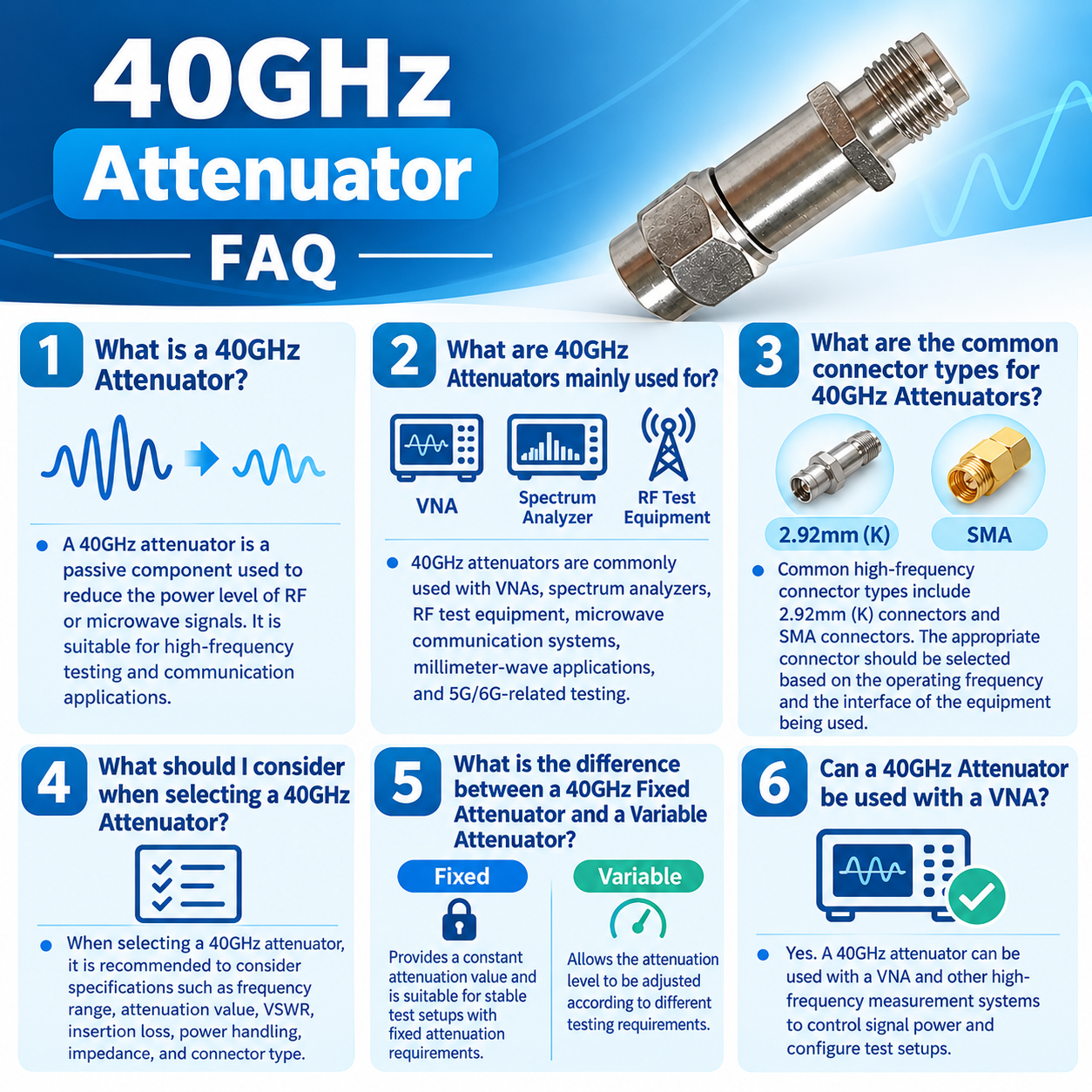
FAQ |40GHz Attenuator
Q1: What is a 40GHz Attenuator?
A 40GHz attenuator is a passive component used to reduce the power level of RF or microwave signals. It is suitable for high-frequency testing and communication applications.
Q2: What are 40GHz Attenuators mainly used for?
40GHz attenuators are commonly used with VNAs, spectrum analyzers, RF test equipment, microwave communication systems, millimeter-wave applications, and 5G/6G-related testing.
Q3: What are the common connector types for 40GHz Attenuators?
Common high-frequency connector types include 2.92mm (K) connectors and SMA connectors. The appropriate connector should be selected based on the operating frequency and the interface of the equipment being used.
Q4: What should I consider when selecting a 40GHz Attenuator?
When selecting a 40GHz attenuator, it is recommended to consider specifications such as frequency range, attenuation value, VSWR, insertion loss, power handling, impedance, and connector type.
Q5: What is the difference between a 40GHz Fixed Attenuator and a Variable Attenuator?
A fixed attenuator provides a constant attenuation value and is suitable for stable test setups with fixed attenuation requirements. A variable attenuator allows the attenuation level to be adjusted according to different testing requirements.
Q6: Can a 40GHz Attenuator be used with a VNA?
Yes. A 40GHz attenuator can be used with a VNA and other high-frequency measurement systems to control signal power and configure test setups.